
What Is Emergent AI?
Emergent AI refers to intelligent behavior that arises naturally when multiple AI systems, agents, or models interact with each other, rather than being explicitly programmed for a specific outcome.
In simple words:
Emergent AI is when AI systems “figure things out together” and produce smart results no single model was trained to do alone.
This concept is inspired by emergence in nature—like how ants build complex colonies or how traffic patterns form without a central controller.
How Emergent AI Works
Emergent AI systems usually involve:
1. Multiple AI Agents
Instead of one large model, several specialized AI agents handle different tasks:
- One agent researches
- Another plans
- Another executes
- Another evaluates results
2. Agent Communication
Agents exchange data, feedback, and goals in real time, improving decisions dynamically.
3. Self-Improving Behavior
The system adapts based on:
- User input
- Environment changes
- Previous successes and failures
This creates unpredictable but intelligent outcomes, which is the core of emergent intelligence.
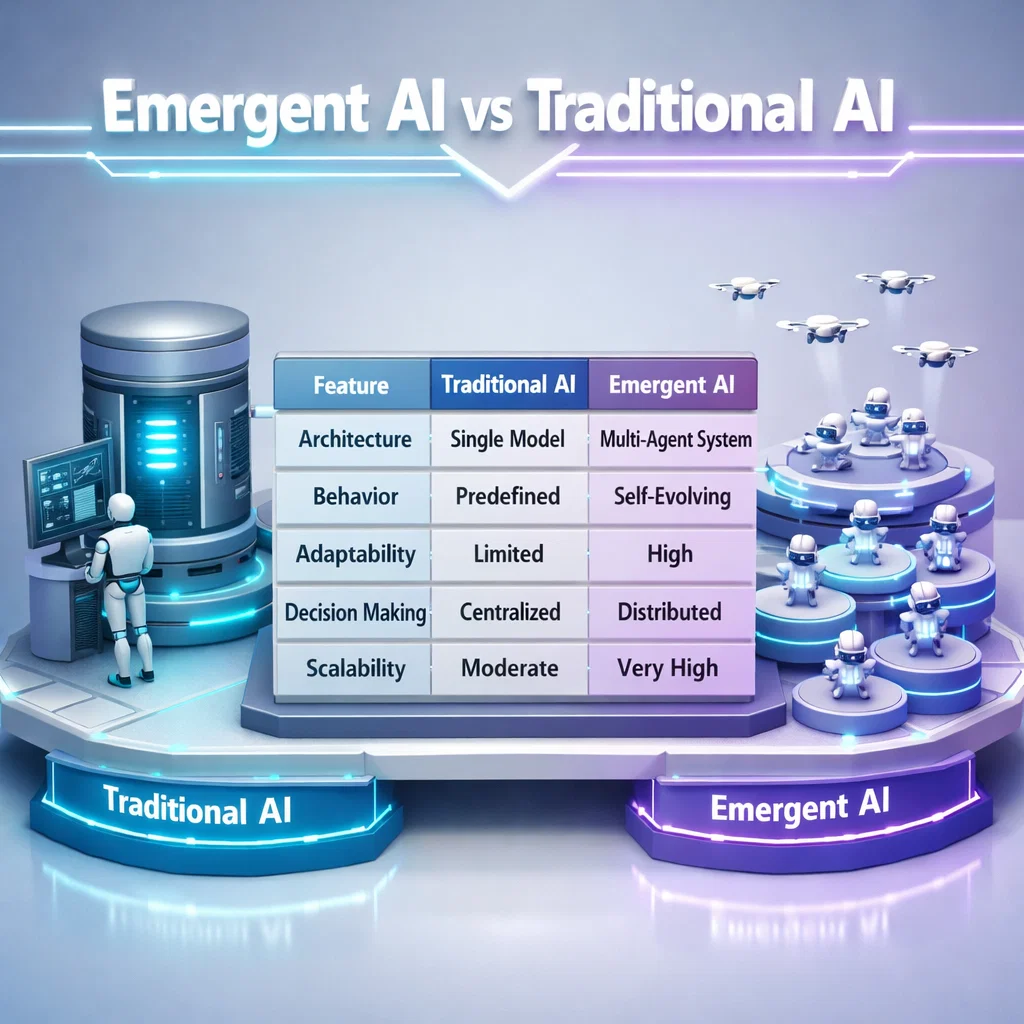
Emergent AI vs Traditional AI
Why Emergent AI Is Important in 2026
Emergent AI is becoming crucial because:
1. Complex Problems Need Distributed Intelligence
Modern challenges like:
- Autonomous businesses
- AI research
- Workflow automation
cannot be solved by a single AI model.
2. Rise of AI Agents
Tools like autonomous agents, AI employees, and self-running workflows rely heavily on emergent behavior.
3. Scalability & Efficiency
Emergent systems:
- Reduce human intervention
- Adapt faster than static AI
- Scale across industries
Real-World Use Cases of Emergent AI
1. Autonomous Research
Multiple agents analyze data, cross-check sources, and generate insights automatically.
2. Business Automation
Emergent AI can:
- Handle customer support
- Optimize marketing
- Manage internal operations
3. Gaming & Simulations
NPCs adapt to player behavior without predefined scripts.
4. Healthcare
AI agents collaborate to:
- Analyze medical data
- Suggest treatments
- Predict outcomes
Popular Emergent AI Tools (2026)
Some platforms using emergent intelligence concepts include:
- Multi-agent AI frameworks
- Autonomous AI assistants
- Workflow automation agents
- Research & planning AI systems
Many modern AI tools don’t market themselves as “Emergent AI” but use it under the hood.
Advantages of Emergent AI
Learns faster
Handles uncertainty better
More human-like reasoning
Reduces manual supervision
Ideal for long-term tasks
Challenges & Risks of Emergent AI
While powerful, emergent AI also brings concerns:
Unpredictable behavior
Harder to control
Ethical risks
Debugging complexity
That’s why AI governance and safety layers are critical in emergent systems.
Future of Emergent AI
By 2027 and beyond, we can expect:
- Fully autonomous AI startups
- AI agents managing businesses
- Emergent AI research teams
- Self-optimizing digital ecosystems
Emergent AI is not replacing humans — it’s augmenting human intelligence at scale.
FAQs About Emergent AI
Is Emergent AI the same as AGI?
No. Emergent AI focuses on collective intelligence, while AGI aims for human-level general intelligence in a single system.
Can Emergent AI think independently?
It doesn’t “think” like humans, but it can reason, adapt, and collaborate without explicit instructions.
Is Emergent AI dangerous?
Not inherently. Risks depend on how it’s designed, monitored, and governed.
Final Thoughts
Emergent AI represents a major shift in artificial intelligence—from isolated models to collaborative, evolving systems.
If you want to stay ahead in AI, automation, and future tech, understanding emergent AI is no longer optional—it’s essential.