
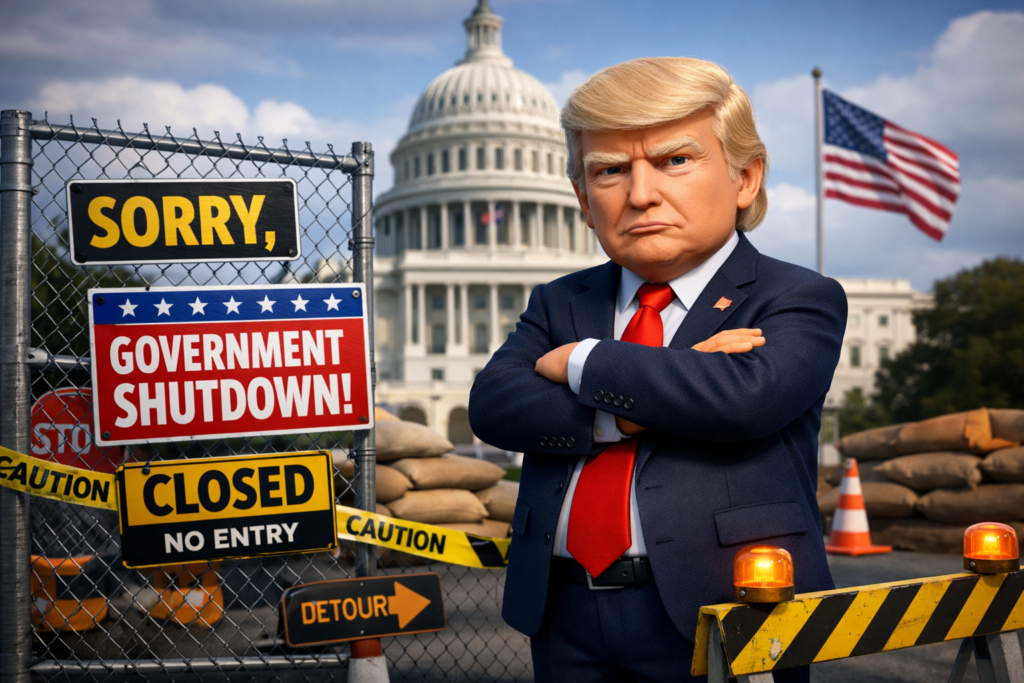
The U.S. federal government goes If Congress fails to pass appropriations (or a continuing resolution) to fund government agencies goes into a shutdown before the fiscal deadline.
In 2025, under the Trump administration passed and temporary funding measures (continuing resolutions) were set to expire. a shutdown loomed because the regular 12 annual appropriations bills had not been.
The Shutdown Under Trump
- President Trump apportioned some of the blame to the Democratic side, claiming that any hardship caused by the shutdown would be caused by the Democrats” for pushing “unreasonable” demands.
- The shutdown would allow the administration to restructure parts of the federal government, such as cutting programs, while signaling its intentions, restructuring agencies, and reducing the size of the federal workforce.
- Healthcare subsidies and other benefit programs were a notable area of contention, especially under the Affordable Care Act. Republicans are in agreement. Unless other policy demands were met, they were hesitant to extend Trump’s agenda.
Immediate Impacts and Observations
- Furloughs may be faced by certain federal employees, but some ‘excepted’ employees (such as essential services like air traffic control) can still work without pay until the shutdown resolves.
- Despite the fact that some programs outside of annual appropriations continue, such as Social Security and certain veterans benefits, many services may slow, delay, or suspend. until funding is restored.
- The Supplemental Nutrition Assistance Program (SNAP) and the Women, Infants, and Children (WIC) nutrition programs are two examples of them. The programs were deemed to be vulnerable if the shutdown is prolonged.
Trump’s Strategic Shift & Messaging
- President Trump saw the shutdown environment as an opportunity instead of seeing it solely as a crisis to be avoided. He mentioned using the opportunity to ‘clear out dead wood, waste, and fraud’ in government and to push for structural changes.
- According to reports, the administration instructed agencies to prepare for’reduction in force’ plans, which could lead to permanent job cuts to programs that didn’t align with Trump’s priorities.
- The media/communication side depicted the shutdown as a political battle: Trump and his allies asserted that Democrats were holding up funding as a leverage, According to Democrats, Trump is using the shutdown as a means to implement policy changes under duress.
Risks & Longer-Term Consequences
- In the past, government shutdowns have caused disruption because of delays in permitting, contract/grant processes, regulatory actions, and general uncertainty emerge.
- Economically, even a small shutdown can slow down growth. Past studies have estimated that a long shutdown reduces GDP growth by 0.1 to 0.2 percentage points in the affected quarter.
- The use of a shutdown to make structural changes sets a precedent – the notion that policy goals can be advanced. Future administrations may be influenced by this to use or avoid shutdown risks, rather than resolve them due to the shutdown.
- The transition from temporary furlough until funding resumes occurs for federal workers and agencies Morale, retention, and institutional capacity could be affected by potential permanent workforce reductions.
What To Watch Going Forward
- (such as healthcare subsidies or other benefits) must be met? program extensions are included)Is a funding deal between Congress and the White House possible, and what conditions.
- The economy, and public confidence longer the stalemate lasts, the more impact it has on services.
- Is the implementing permanent changes to agencies or programs shutdown process responsible for announcing
- (which side is held responsible) and its impact on the upcoming elections or budget negotiations Public perception of blame for the shutdown.
- Annual appropriations-dependent programs (such as grants, new student loans, and housing programs) are affected if funding is not available.
The US has sanctioned Russia’s two largest oil companies and called on Moscow to agree to an immediate ceasefire to consent to an immediate cessation of hostilities.
The Trump administration on Wednesday imposed sanctions on Russia’s two largest oil companies as it called on Moscow to agree to an immediate ceasefire in the war with Ukraine.
President Donald Trump had for weeks signaled he could impose penalties against Russia for its continuation of the war but had failed to take major punitive measures until Wednesday. The announcement came as Trump said he had “canceled” an anticipated meeting with Putin because he “didn’t feel like we were going to get to the place we have to get.”
In remarks in the Oval Office, Trump explained he “felt it was time” for the sanctions, noting he “waited a long time” to impose them. Still, the US president said he hopes “they won’t be on for long” because the war will end.
White House releases list of donors for Trump’s multi-million-dollar ballroom
Apple, Amazon, Lockheed Martin, Microsoft, Google, Coinbase, Comcast and Meta are just some of the major companies who have made donations to build President Donald Trump’s proposed 90,000-square-foot ballroom, according to the White House.
Trump has repeatedly said that work on the ballroom is privately funded by himself and donors and will cost nothing to taxpayers.
On Wednesday, Trump discussed his plans for the ballroom, saying it will cost “about $300 million.” The administration previously put the cost of the ballroom project at $200 million.
Commerce Secretary Howard Lutnick and his family; and the Adelson family. Trump awarded Miriam Adelson, a Republican megadonor, the Presidential Medal of Freedom in 2018. Additional donors include co-founders of cryptocurrency exchange Gemini, Tyler and Cameron Winklevoss.
Read the list of White House ballroom donors:
- Altria Group, Inc.
- Amazon
- Apple
- Coinbase
- Comcast Corporation
- J. Pepe and Emilia Fanjul
- Hard Rock International
- HP Inc.
- Lockheed Martin
- Meta Platforms
- Micron Technology
- Microsoft
- NextEra Energy, Inc.
- Ripple
- T-Mobile
- Tether America
- Union Pacific Railroad
- Adelson Family Foundation
- Stefan E. Brodie
- Betty Wold Johnson Foundation
- Charles and Marissa Cascarilla
- Edward and Shari Glazer
- Harold Hamm
- Benjamin Leon Jr.
- The Lutnick Family
- The Laura & Isaac Perlmutter Foundation
- Paolo Tiramani
- Cameron Winklevoss
- Tyler Winklevoss
The US military conducted lethal strikes against two boats in the eastern Pacific this week, killing all people on board each vessel, according to Secretary of Defense Pete Hegseth.
The two strikes on vessels in the Pacific — the eighth and ninth known strikes by the US military on alleged drug-smuggling vessels since the start of September — appear to mark an expansion of the US military campaign, with all seven previous strikes targeting boats in the Caribbean Sea.
At least 37 people in total have been killed in the nine strikes, officials have said.
“Narco-terrorists intending to bring poison to our shores, will find no safe harbor anywhere in our hemisphere,” Hegseth said on X Wednesday, noting a Tuesday strike in the Pacific had killed both people on board.
Hegseth said the boat in that strike was “being operated by a Designated Terrorist Organization and conducting narco-trafficking in the Eastern Pacific” and “was known by our intelligence to be involved in illicit narcotics smuggling, was transiting along a known narco-trafficking transit route, and carrying narcotics.”
Later Wednesday, Hegseth said the US conducted a lethal strike on a second suspected drug boat in the eastern Pacific, killing all three people on board.
“Today, at the direction of President Trump, the Department of War carried out yet another lethal kinetic strike on a vessel operated by a Designated Terrorist Organization (DTO),” Hegseth wrote in the post.
The secretary added that no US forces were hurt in the two Pacific strikes and compared the traffickers to al Qaeda.
“Just as Al Qaeda waged war on our homeland, these cartels are waging war on our border and our people. There will be no refuge or forgiveness—only justice,” he wrote in his first post.
The Trump administration has produced a classified legal opinion seeking to justify lethal strikes against a secret and expansive list of cartels and suspected drug traffickers, CNN has reported.
The opinion is significant, legal experts previously told CNN, because it treats drug traffickers as enemy combatants who can be summarily killed without any kind of judicial review.
The US struck at least two other vessels last week in the Caribbean, one of which did not kill everyone on board. Rather than hold two survivors detained by the US Navy after one of those strikes, the US repatriated the survivors back to their home countries of Ecuador and Colombia.
Takeaways from the second general election debate in the NYC mayoral race
Democrat Zohran Mamdani clashed with independent Andrew Cuomo from the first moments of Wednesday’s second and final general election debate for New York City mayor. Cuomo called Mamdani divisive and said he lacked experience or new ideas, while Mamdani said the former governor, down in the polls, was a “desperate man lashing out.”
Cuomo was looking for a moment to change the race’s contours less than two weeks from Election Day while Mamdani both sought to lock in his lead and establish himself as winning the “battle over the soul” of the national Democratic Party. The two tore into each other in strikingly personal terms on their backgrounds, their policy ideas and how each would address antisemitism.
Republican nominee Curtis Sliwa, meanwhile, reprised his wildcard role as he refuses to bow to a pressure campaign from some in his party to leave the race.
Here are key moments from the debate:
Cuomo gives Mamdani a dressing-down about experience
In a pivot from his frequent reference to his time in government, Cuomo sought to put distance between his record as governor and New York City’s municipal failures. Notably for someone elected governor three times, Cuomo argued that “the city has been getting screwed by the state, and that has to change.”
But the exchange gave Mamdani an opening to attack Cuomo for his record as governor.
“The governor doesn’t build housing in New York City,” Cuomo said in response to a question on housing policy.
“Not if it’s you,” Mamdani retorted.
That led to Cuomo accused Mamdani of never having “accomplished anything.”
“I did things; you have never had a job,” Cuomo said motioning towards Mamdani and drawing applause from the crowd. “There is no reason to believe you have any merit or qualification for 8.5 million lives. You don’t know how to run a government.”
He went on to paint Mamdani as an inexperienced legislator who is unprepared to lead America’s biggest city and would be dangerous in the event of an emergency.
“You don’t know how to handle an emergency, and you literally never proposed a bill on anything that you’re not talking about in your campaign,” Cuomo said, his voice rising.
Democratic Sen. Jeff Merkley now holds the record for third longest Senate floor speech in modern history, after delivering remarks for more than 22 hours.
Merkley began speaking on the Senate floor after announcing he would protest what he called President Donald Trump’s “grave threats to democracy.”
“I’ve come to the Senate floor tonight to ring the alarm bells. We’re in the most perilous moment, the biggest threat to our republic since the Civil War. President Trump is shredding our Constitution,” the Oregon Democrat, who turns 69 on Friday, said after kicking off his remarks at 6:24 p.m. ET Tuesday.
In total, the senator spoke for 22 hours and 36 minutes.
Shortly after his remarks came to an end, Merkley told CNN’s Manu Raju that he almost fainted at one point and noted that he had been dehydrating himself since Monday morning.
“It is about dehydration. My last sip of anything — well, I might have had a micro-sip – was breakfast on Monday morning on the plane. That was my last food too. And I wasn’t really sure that was going to work out, and I said, ‘I hope I’m not fasting for no reason.’ I love to eat,” said Merkley, later adding that he had a slice of pizza just off the floor.
He said “there was one moment” where he thought he might faint, and noted that he had injured his back while running a few weeks ago. “My back hurt the whole damn time,” said Merkley.
Asked about gallery staff and Capitol Police, who are working without pay during the shutdown, being forced to work through the night during his speech, Merkley said it was “outrageous” that there are no negotiations happening to end the shutdown, and noted, “having this speech tonight or not having this tonight isn’t going to speed up paychecks.”