
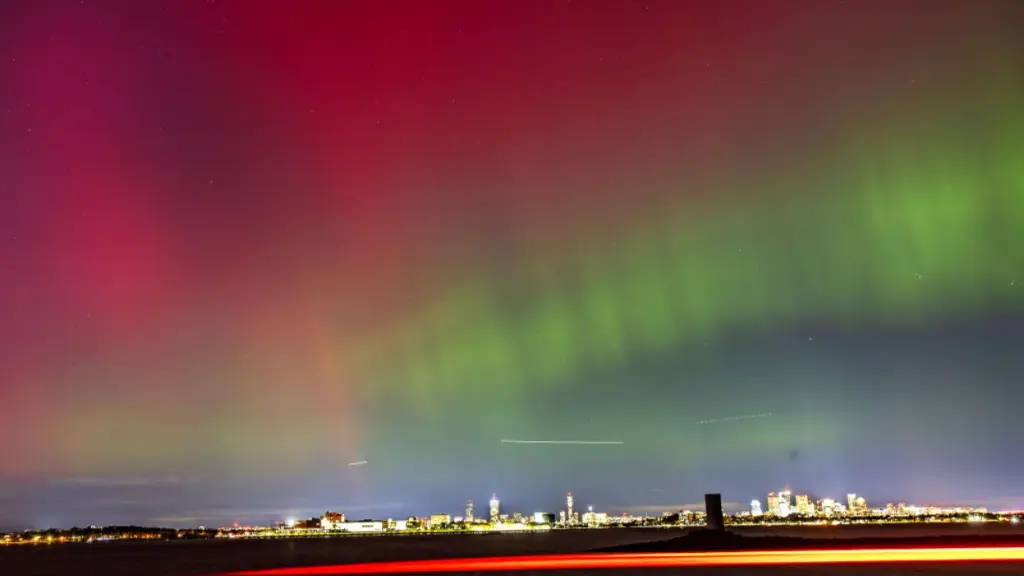
If you’ve recently seen glowing green, purple, or red waves lighting up the night sky — you’re not alone! The Northern Lights, or Aurora Borealis, have been visible much farther south than usual, dazzling viewers across the United States, from California to Florida. But what exactly causes this beautiful phenomenon, and why is it showing up in places it normally doesn’t?
The Science Behind the Northern Lights
The Northern Lights occur when charged particles from the Sun — mostly electrons and protons — collide with gases in Earth’s atmosphere.
When these solar particles hit atoms of oxygen and nitrogen high in the sky, they release energy in the form of light. That’s what creates the shimmering waves of color we call the aurora.
Each color represents a different kind of gas and altitude:
- 💚 Green: Oxygen, about 60 miles above Earth.
- ❤️ Red: High-altitude oxygen, up to 200 miles high.
- 💜 Purple or Blue: Nitrogen molecules.
Why the Lights Are More Visible in 2025
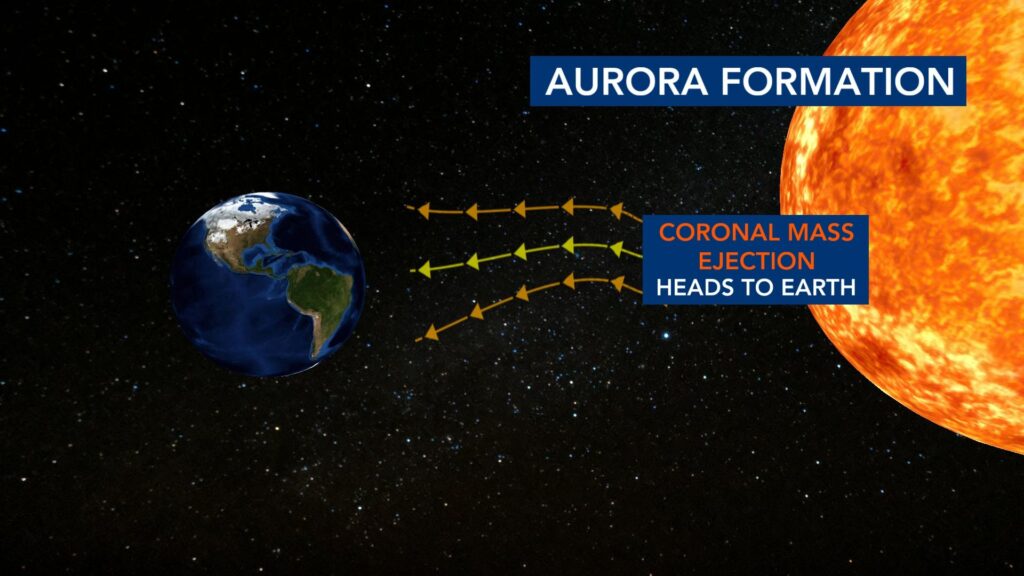
Recently, a powerful geomagnetic storm — triggered by an intense solar flare or coronal mass ejection (CME) — sent a burst of solar energy toward Earth.
When that wave of charged particles hit our planet’s magnetic field, it created strong auroras that extended much farther south than usual.
This storm was part of the Sun’s 11-year solar cycle, which is currently approaching its solar maximum — the most active phase when sunspots and solar flares become frequent. That means we could see more auroras in the coming months!
Auroras Seen Across the U.S.
Usually, the Northern Lights are visible near the Arctic Circle — places like Alaska, Canada, or Norway. But this time, people across the Midwest, New York, Pennsylvania, Texas, and even Arizona captured the spectacle on camera.
Social media exploded with hashtags like #NorthernLights and #AuroraWatch, driving millions of searches overnight.
Can You See the Next Aurora?
Here are a few tips if you want to catch the next light show:
- Check space weather forecasts — sites like NOAA’s Space Weather Prediction Center post real-time aurora alerts.
- Find a dark sky area — far from city lights.
- Look north after sunset — the best views are usually between 10 PM and 2 AM.
- Bring a camera — auroras often look even brighter in photos!
A Rare Sky Show That Unites Us
The Northern Lights are more than a scientific wonder — they remind us how powerful and connected our planet is to the Sun. Whether you’re in Alaska or Alabama, seeing the sky dance with color is a moment that makes everyone look up in awe.
So keep your eyes open — the next aurora could be coming soon to a sky near you.
Geomagnetic Storm Watches in Effect, to include G4 (Severe) potential for 12 November. The current list of Watches include: 11 Nov G2 (Moderate); 12 Nov G4 (Severe); and 13 Nov G3 (Strong). These Watches are in response to potential geomagnetic storm effects related to coronal mass ejections (CME) that have erupted from the Sun over the past several days.
These events include CME activity from 9 November through the early morning of 12 November. The most recent CME occurred early on 11 Nov and is the most energetic and fastest of the CMEs. This CME was associated with an X5.1 solar flare (R3; Strong) that peaked at 1004 UTC (5:04 am EST) on 11 Nov. This CME is also associated with a moderate level solar radiation storm (S2) that is currently in progress.
The forecast is tough due to this latest CME’s predominant ejecta aimed north and ahead of Earth’s orbit; additionally the previous CMEs are in the mix and anticipated to have some Earth-arrival influences prior to the 12 Nov CME arrival. Confidence in an Earth-component to the most recent CME is high, while timing has a moderate level of certainty.
As always with these events, the intensity of the CME will not be know with better certainty until it arrives 1 million miles from Earth and is observed by the solar wind observatories at that location. It is at that point that any needed Warning decisions can be made by SWPC forecasters. So, for now, SWPC believes there is a potential for G4 levels upon CME arrival and/or as the CME passage progresses. Stay space weather aware and follow the latest information, forecasts, and updates at spaceweather.gov
But a geomagnetic storm with enough energy output has the potential to disrupt satellites, communications systems, and even ground-based technologies like power grids if directed at our planet. In extreme cases, powerful solar events even pose risks to spacecraft and astronauts, NASA says.

In this case, “infrastructure operators have been notified to mitigate any possible impacts,” NOAA’s Space Weather Prediction Center warned in its alert.
In May 2024, a historically powerful geomagnetic storm was responsible for some reports of power grid irregularities and interference with GPS signals – even farming equipment.