
When starting a career in web development, one common question developers ask is Laravel vs Core PHP: which one should I learn? Both are powerful in their own way, but the right choice depends on your goals, experience level, and the type of projects you want to build.
In this guide, we’ll compare Laravel vs Core PHP in terms of learning curve, performance, security, job demand, and real-world use cases to help you decide.
What Is Core PHP?
Core PHP (or plain PHP) refers to writing PHP code without using any framework. You manually handle routing, database connections, authentication, and security.
Pros of Core PHP
- Full control over code
- Lightweight and fast for small projects
- Strong foundation for understanding PHP basics
- No framework dependency
Cons of Core PHP
- Time-consuming development
- Harder to maintain large applications
- Security must be handled manually
- Not scalable for complex projects
What Is Laravel?
Laravel is a modern PHP framework that follows the MVC (Model–View–Controller) architecture. It simplifies development by providing built-in tools for routing, authentication, database management, and security.
Pros of Laravel
- Clean and readable syntax
- Built-in security features
- Faster development with ready-made tools
- Strong community support
- Highly scalable and maintainable
Cons of Laravel
- Slight learning curve for beginners
- Heavier than Core PHP
- Requires understanding of framework concepts
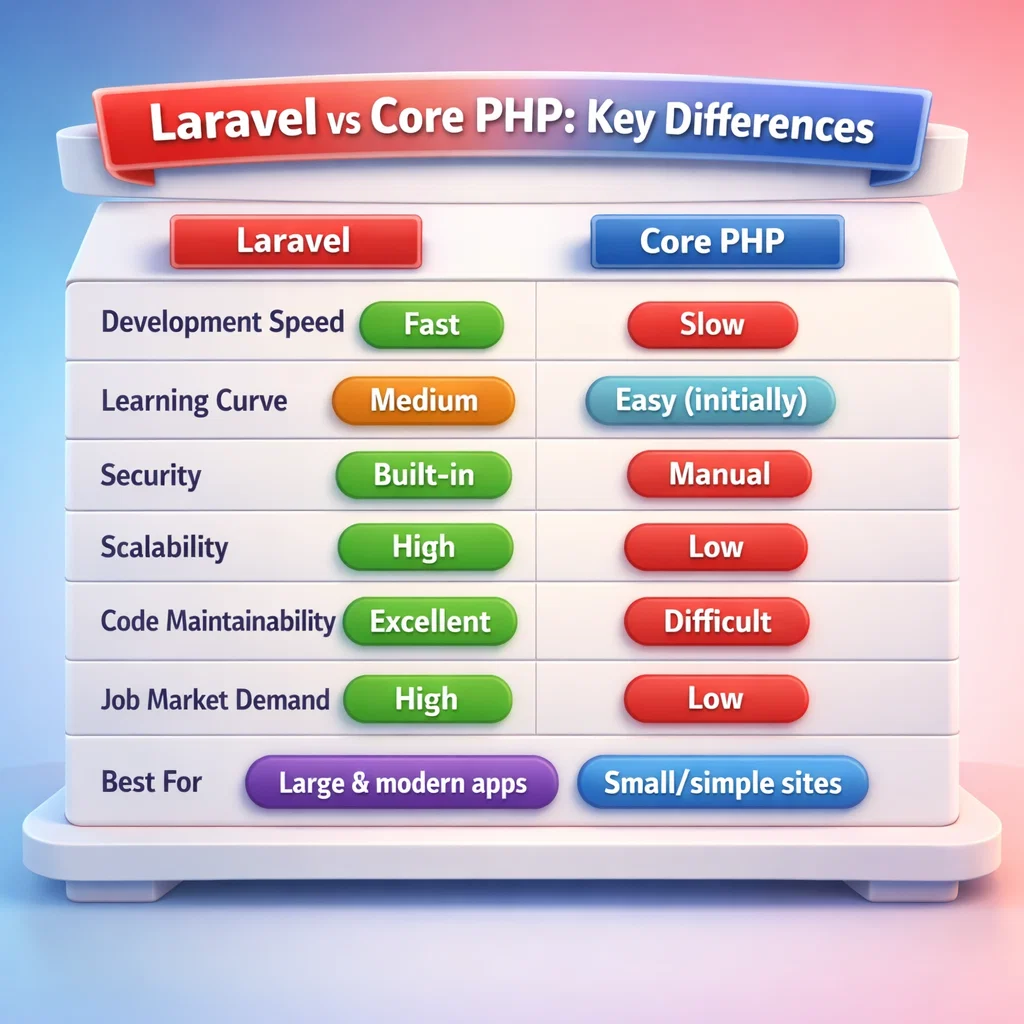
Laravel vs Core PHP: Key Differences
Which One Is Better for Beginners?
If you are a complete beginner, learning Core PHP first is recommended. It helps you understand:
- PHP syntax
- How the backend works
- Database handling (MySQL)
- Sessions and forms
However, once you understand the basics, switching to Laravel is the smartest move.
Laravel vs Core PHP for Jobs & Career
In 2026, most companies prefer developers who know Laravel, not just Core PHP.
Job Market Reality
- Laravel developers are in high demand
- Most PHP job listings require Laravel
- Freelance and remote projects prefer frameworks
- Enterprise applications rely on Laravel
Core PHP alone is rarely enough for a professional career.
Performance: Laravel vs Core PHP
- Core PHP can be faster for very small projects
- Laravel is optimized and performs well for large applications
- Laravel caching, queues, and optimization tools make it production-ready
For real-world apps, performance difference is usually negligible.
Security Comparison
Security is a major factor in Laravel vs Core PHP.
- Laravel offers:
- CSRF protection
- SQL injection prevention
- Password hashing
- Authentication scaffolding
- In Core PHP, all security must be coded manually
Laravel is far more secure by default.
When Should You Choose Core PHP?
Choose Core PHP if:
- You want to learn PHP fundamentals
- You’re building a small or educational project
- You need lightweight scripts
- You want to understand how frameworks work internally
When Should You Choose Laravel?
Choose Laravel if:
- You want a professional PHP career
- You’re building large or scalable applications
- You want faster development
- You plan to work in teams or companies
- You want better job opportunities
Final Verdict: Laravel vs Core PHP – Which One Should You Learn?
Best approach: Learn both — but in the right order.
Start with Core PHP to understand the basics
Move to Laravel for real-world development and career growth
Short Answer:
- Beginner: Core PHP → Laravel
- Career-focused developer: Laravel
- Modern web development: Laravel wins