
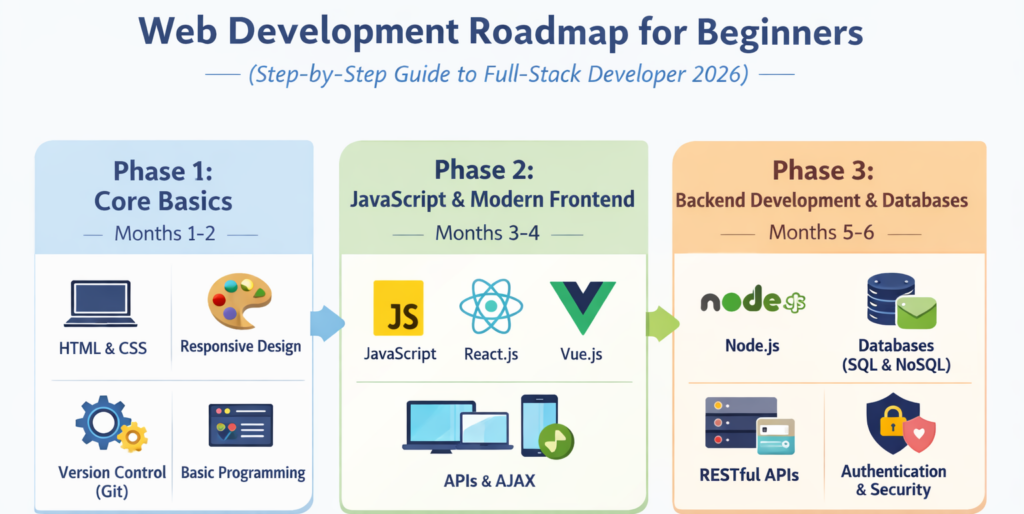
Web Development Roadmap 2026: Steps to Full-Stack Success
2026 Web Development Roadmap for Beginners is a complete guide to learn HTML, CSS, JavaScript, and full-stack development step-by-step.
Introduction
The 2026 Web Development Roadmap for Beginners is a complete step-by-step guide for learning web development from scratch.
Web development in 2026 is evolving rapidly with advancements in AI and modern technologies. For beginners, having a clear roadmap is essential to navigate this dynamic field effectively. This guide will assist you in progressing from a novice to a competent full-stack developer step-by-step, ensuring you acquire the necessary skills and knowledge to succeed.
Phase 1: Core Basics (Months 1-2)
Before diving into advanced topics, it’s crucial to build a strong foundation in web development. Understanding how the web operates is the first step towards becoming a proficient developer.
Understanding How the Web Works
Learn the following:
- HTTP / HTTPS: Understand the protocols that power the web.
- DNS: Learn how domain names translate to IP addresses.
- Browsers & servers: Understand client-server architecture.
- HTML5: Learn the structure of web pages.
- Headings, paragraphs, and semantic tags: Importance of proper HTML semantics.
- Forms & inputs: Create interactive web forms.
- CSS3: Learn how to style web pages effectively.
- Colors & fonts: Explore typography and color theory for web design.
- Flexbox & Grid: Master modern layout techniques.
- Responsive Design: Ensure your sites look good on all devices.
- Media queries: Adapt designs based on screen size.
- Mobile-first design: Prioritize mobile users in your design approach.
- Git & GitHub: Collaborate and version control your projects.
Pro Tip: Build a simple portfolio website during this phase. It will not only showcase your work but also reinforce your learning.
Phase 2: JavaScript & Modern Frontend (Months 3-4)
Now that you have a solid foundation, it’s time to make your website interactive and dynamic.
JavaScript (ES6+)
Key Areas to Focus On:
- DOM manipulation: Learn how to interact with the Document Object Model.
- Events: Understand how to handle user interactions.
- Fetch API & Promises: Learn how to make network requests.
- TypeScript: Recommended for 2026 for type safety and improved debugging.
- Frontend Frameworks: Choose one to specialize in.
Choose Your Framework:
- React
- Next.js
- Vue.js
Explore styling tools as well, such as Tailwind CSS and SCSS, to enhance the visual appeal of your applications.
Project Idea: Build a dynamic to-do app or a collaborative writing tool to apply your skills practically.
Phase 3: Backend Development & Databases (Months 5-6)
To become a full-stack developer, you must learn how to manage the backend of applications.
Backend Development Topics:
- Node.js: A JavaScript runtime for building server-side applications.
- Express.js: A web framework for Node.js.
- Databases: Understand both SQL and NoSQL databases.
- PostgreSQL: A powerful SQL database for structured data.
- MongoDB: A NoSQL database for handling unstructured data.
- APIs: Learn to create and consume REST APIs.
- Authentication: Implement secure user authentication (JWT).
Project Idea: Create a login system integrated with a database to manage user data securely.
Phase 4: 2026 Specializations & Deployment (Months 7+)
Differentiate yourself in the competitive job market by specializing in modern technologies.
AI Integration:
- Utilize AI tools like chatbots for enhanced user engagement.
- Implement smart recommendations to personalize user experiences.
- Explore content generation AI to automate tasks.
Deployment Tools:
- Vercel: For deploying frontend applications.
- Netlify: For continuous deployment and hosting.
Testing: Master testing frameworks like Jest and Cypress to ensure application reliability.
Project Idea: Develop an AI-powered web application that utilizes machine learning for improved functionality.
Habits for Success
To achieve your goals, focus on building real projects. Aim to create:
- A comprehensive portfolio website
- An e-commerce application
- A project powered by AI technologies
Engage with official documentation regularly. Relying solely on tutorials can hinder your understanding; therefore, prioritize learning from original resources.
Using AI Smartly
Incorporate AI into your workflow to boost efficiency:
- Utilize AI for concept understanding.
- Leverage AI tools for debugging your code.
- Implement AI to enhance your productivity.
However, always remember that self-practice is vital for true mastery.
Conclusion
The web development roadmap for 2026 emphasizes not only coding skills but also the integration of: