
How Modern AI Learned to Understand the World
Artificial intelligence is often judged by what it creates—text, images, recommendations, or automation. But behind every output lies a deeper process: understanding.
That understanding is powered by encoders.
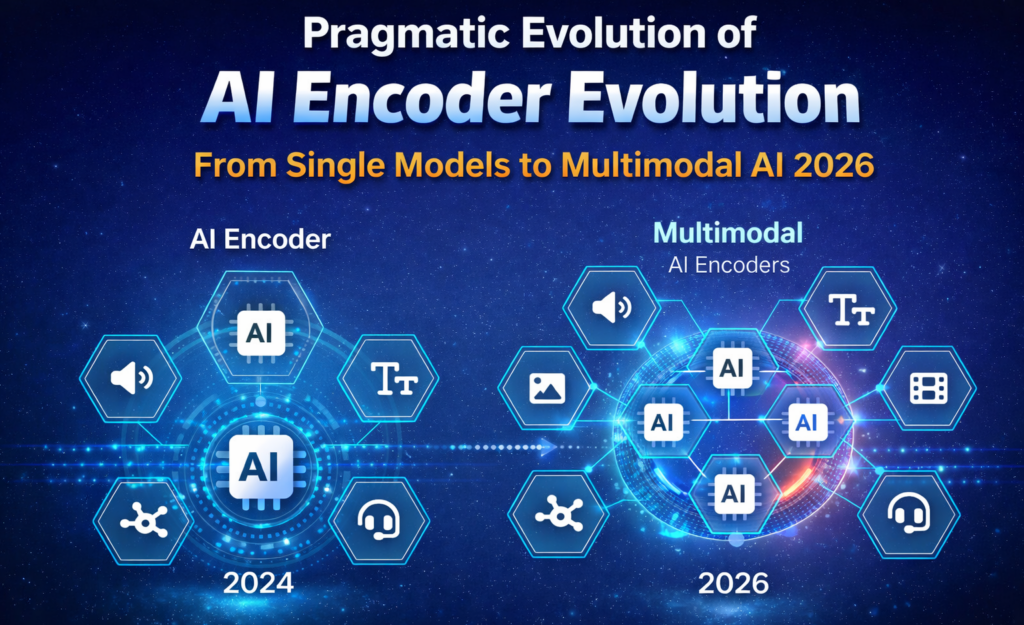
Pragmatic Evolution Over time, encoders have gone through what can be best described as a pragmatic evolution—a practical, need-driven transformation from simple data processors to intelligent, multimodal systems.
This article explores two key journeys:
The evolution of encoders from single-purpose models to advanced systems
The rise of multimodal AI in modern applications
- The Early Stage: Single-Model Encoding
In the beginning, encoders were not intelligent—they were functional.
Developers manually converted data into numerical formats:
Categories → Numbers
Text → Tokens
Images → Pixel values
These early systems worked, but only at a surface level.
- Limitations
- No understanding of meaning
- No relationship between data points
- Fully dependent on human-defined rules
For example, an early recommendation system could suggest products based on categories—but it couldn’t understand user intent.
Result: Systems processed data, but didn’t understand it.
- Learning Begins: Neural Network Encoders
The shift began with neural networks.
Pragmatic Evolution Encoders started learning patterns instead of relying on fixed rules.
What changed?
- Systems trained on large datasets
- Patterns discovered automatically
- Reduced human dependency
Example: Image Recognition
Instead of defining:
“Cats have ears, whiskers, tails”
The model learns:
Visual patterns from thousands of images
In Language
Words became vectors:
Capturing similarity and meaning
Enabling smarter search and recommendations
This was the first step toward intelligent encoding.
- Autoencoders: Focusing on What Matters
Autoencoders introduced a powerful idea:
Compress → Understand → Reconstruct
To reconstruct data accurately, the model must learn:
- What’s important
- What can be ignored
- Real-world Applications
- Fraud detection (detect anomalies)
- Image compression
- Noise reduction
This marked a shift from data handling → meaningful representation.
- Transformer Era: Context Awareness
The biggest leap came with transformer-based encoders like Transformer.
Why Transformers Changed Everything
Process entire input at once
Understand relationships between words/data
Capture context effectively
Example
“She saw the man with the telescope.”
Transformers analyze:
Sentence structure
Context relationships
Result: More accurate understanding
This powers:
Chatbots
Search engines
Translation tools
- Modern Shift: Multimodal AI Evolution
Now we enter the second major phase:
Multimodal AI
Encoders no longer handle just one type of data.
They now process:
- Text
- Images
- Audio
- Video
What Makes This Evolution “Pragmatic”?
It’s driven by real-world needs:
Users want faster interactions
More natural inputs
Less manual effort
Examples
Upload an image → Find similar products
Take a photo → Ask a question about it
Speak + text → Get contextual responses
AI is no longer single-channel—it’s multi-sensory.
- Encoders in Everyday Life
Most users don’t see encoders—but they experience them daily.
Where They Work
Streaming platforms → Personalized recommendations
Maps → Traffic prediction
Healthcare → Medical image analysis
E-commerce → Smart product suggestions
Pragmatic Evolution Encoders quietly power modern digital experiences.
- Challenges in the Pragmatic Evolution
Progress brings complexity.
- Computational Cost
High GPU requirements
Energy consumption concerns - Bias in Data
Models reflect training data
Can reinforce inequalities - Privacy Issues
Sensitive data processing
Need for secure AI systems
Pragmatic Evolution These challenges define the next phase of improvement.
- The Future: Efficient & Adaptive AI
The next stage of pragmatic evolution focuses on:
Efficiency
Smaller, faster models
Lower resource consumption
Personalization
AI adapting to individual users
Real-time learning
Seamless Multimodality
Better integration of text + vision + audio
Example
Education platforms could:
Adjust teaching style per student
Improve learning outcomes dynamically
Conclusion: From Data to Understanding
The Pragmatic Evolution of encoders is not just technical—it’s practical.
- From:Rule-based systems
- To:Learning models
- To:Context-aware transformers
- To:Multimodal intelligence
This journey defines the pragmatic evolution of AI.
Encoders have moved from simply processing data to truly understanding the world.